Raven O’Cátheseigh
CONTEMPORARY ARTIST
“The ancient world never left us. It simply speaks now in coded brushstrokes.”
— Raven O’Cátheseigh
Artist's Statement & Biography
Raven O’Cátheseigh is a contemporary symbolic painter and animator whose practice explores goddess symbology, mythic imagery, and ritual transformation.
BIOGRAPHY
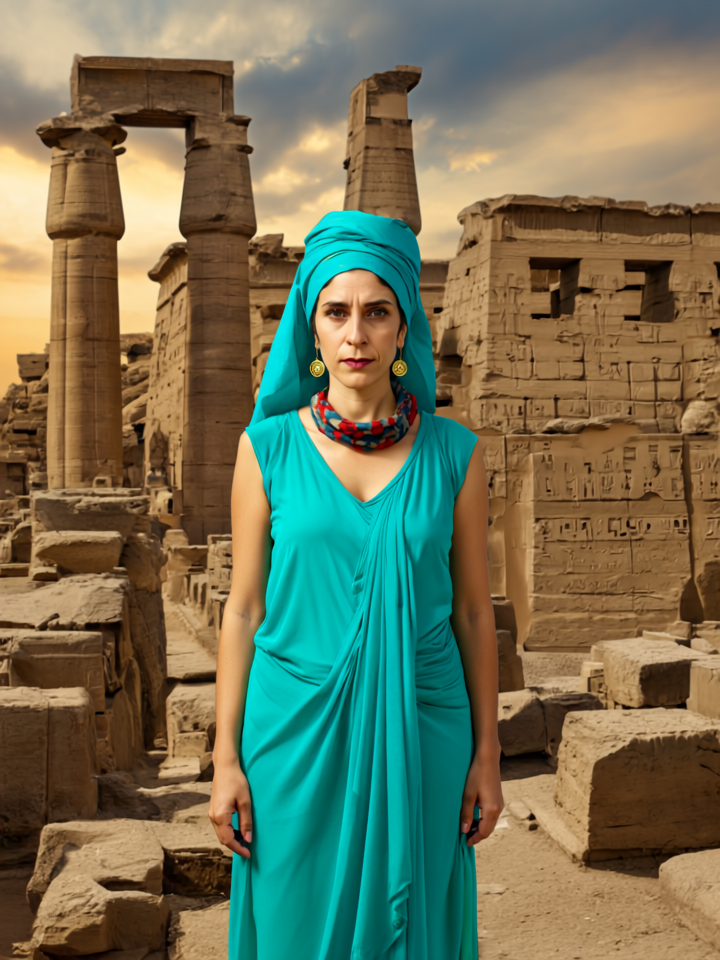
Raven O’Cátheseigh grew up in areas marked by urban poverty and social instability. Fleeing the male violence and criminality that surrounded her, she became nomadic, spending long periods travelling across Europe, Africa, the Near East, and the Mediterranean, finding solace in the remnants of an ancient world where women had once held power. Exploring ancient Goddess temples and shrines, she began noticing the symbolic traces of these forgotten goddess cultures in our contemporary world. She perceived them as signs calling her to explore and restore the divine feminine through contemporary art. As she began to develop ritual artistic practices, she used symbolic forms to navigate impressions that often overwhelmed her. She later discovered that the structures within goddess imagery echoed the logic of digital systems, which she used as portals to engage with these worlds.
RAVEN O'CATHESEIGH
ARTIST STATEMENT
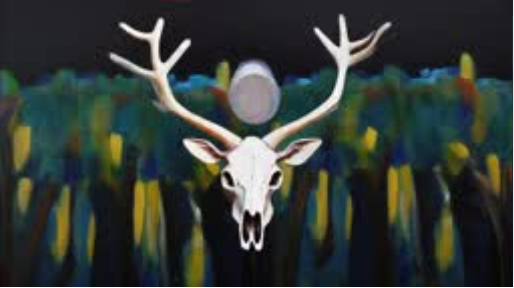
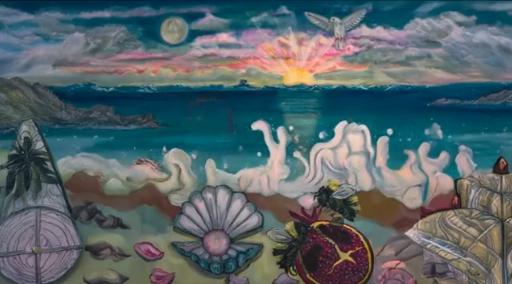
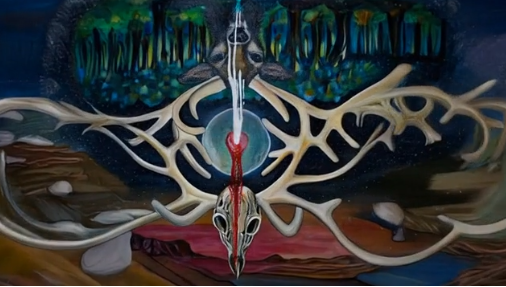
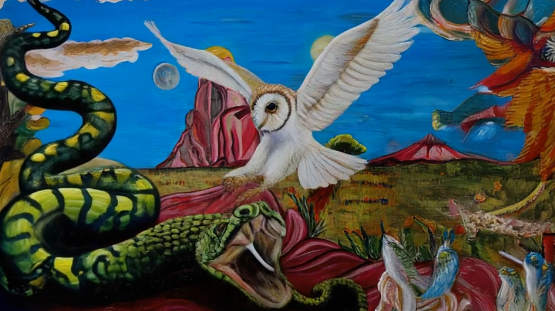
Raven O’Cátheseigh’s practice centres on the resurrection of feminine symbolic power through large-scale acrylic paintings and short surreal animations that operate as portals into lost mythic realms. She paints not the bodies of goddesses, but their symbols: Athena’s owl and ouroboros, Artemis’s deer and skull, Aphrodite’s wave and bees, Hestia’s hearth fire and donkey, and the ritual motifs associated with autonomous, sovereign feminine deities. These icons are assembled into dream-like environments—part temple, part psychological landscape—forming ritual paintings intended as gateways to worlds concealed by the patriarchy.
Raven’s approach echoes Aby Warburg’s concept of the pathosformel, treating symbolic motifs as surviving emotional intensities that migrate across time. By liberating these forms from narrative myth, O’Cátheseigh creates spaces where ancestral feminine knowledge can resurface. Her work is informed by feminist theorists such as Silvia Federici, who documents the suppression of pre-modern female cosmologies, and Hélène Cixous, whose writing on the feminine imaginary underlines the necessity of reclaiming erased spiritual lineages. Raven’s symbolic worlds respond to these discourses by reconstructing goddess power without resorting to figuration or idealisation.
Once a painting is complete, O’Cátheseigh expands its metaphysical field through short surreal animations. Sound, movement, and symbolic metamorphosis merge to create an immersive ritual encounter with paint, artificial intelligence, sound, and film. Here she collaborates with artificial intelligence: not as a mechanistic tool but as a generative interlocutor capable of revealing hidden layers and intensifying the work’s symbolic charge. Her process aligns with Karen Barad’s theorisation of diffraction, allowing the images to refract, divide, and reform into new constellations of meaning. In this expanded digital realm, goddess symbols become active agents, unfolding into posthuman mythological spaces.
Situated within the lineage of posthuman feminist art, O’Cátheseigh’s practice resonates with Donna Haraway’s conception of the cyborg as a mythic figure that complicates binaries between nature, technology, and the sacred. By merging traditional acrylic painting with AI-driven metamorphosis, she creates hybrid portals in which ancient feminine power becomes technologically reborn.
Across both painting and animation, Raven O’Cátheseigh reanimates suppressed goddess lineages, constructing visual rites that honour the autonomous feminine while imagining new mythic futures in uncharted terrains of digital space.