CASSIE ANGELIS
CONTEMPORARY ARTIST
“I follow the places where perception exceeds language.”
— Cassie Angelis
Artist Statement & Biography
Cassie Angelis is a contemporary digital and hybrid artist exploring abstraction, transformation, and posthuman aesthetics through AI-assisted and painterly processes.
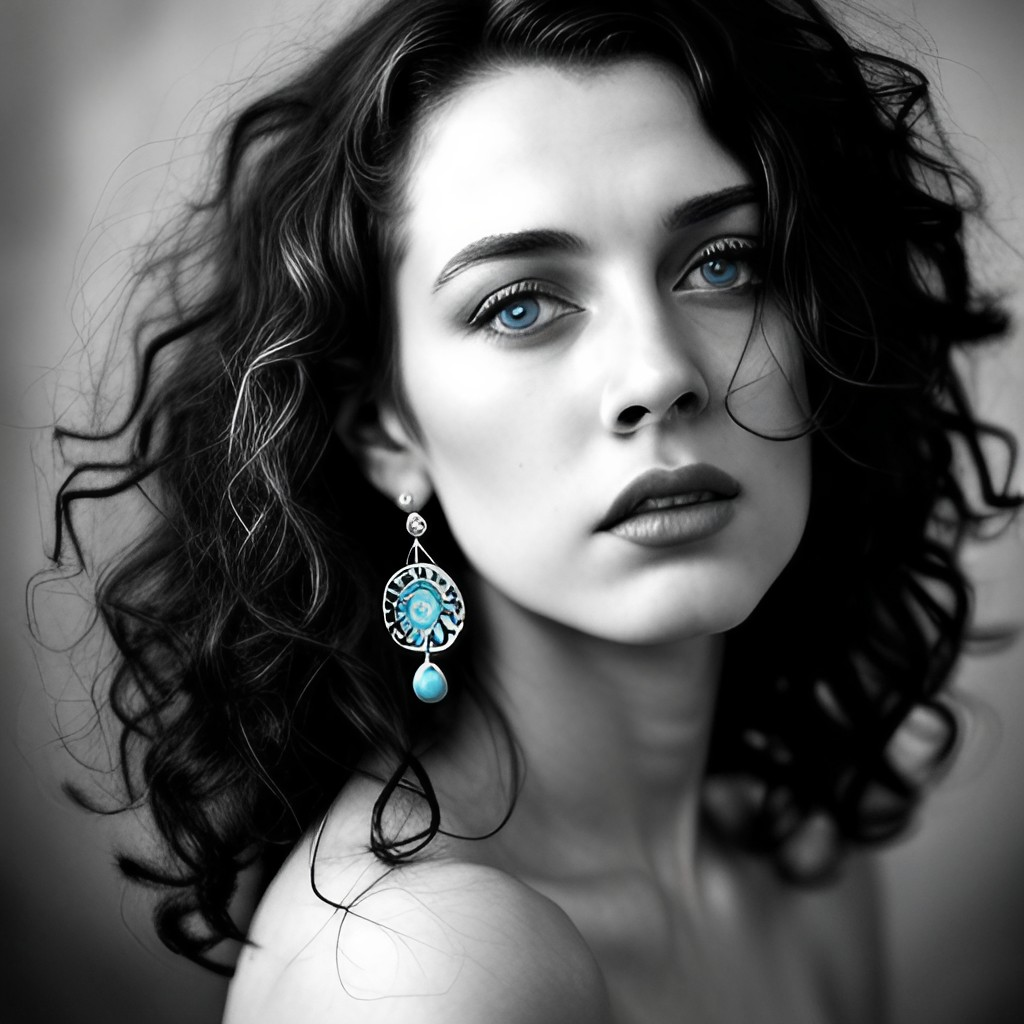
BIOGRAPHY
Cassie Angelis spent much of her childhood on the Cornish coast, where she studied the shifting patterns of rock pools and first recognised her heightened psychic sensitivity. Her perceptiveness made her an outsider at school, and she became increasingly reclusive as the accuracy of her intuitions unsettled those around her. During adolescence she turned to spirit writing to manage impressions that often overwhelmed her, and later found that its internal structure echoed the logic of digital systems. Over time, she began to understand these impressions as portals to other worlds — thresholds not unlike the computer screen itself, where psychic phenomena and digital architectures seemed to mirror one another. These early experiences with perception, isolation, and technology form the foundation of her artistic sensibility, shaping a practice that navigates the thin, volatile membrane between the visible and the unseen.
CASSIE ANGELIS
ARTIST STATEMENT
Cassie Angelis’ practice examines hybrid authorship and posthuman image making through a methodology that moves between spirit writing, AI generation, painting, and digital recomposition. Her process begins with spirit writing, where immediate visual impressions are articulated as concise textual fragments. These texts become prompts for AI seed images, connecting her work to the linguistic strategies explored by artists such as Adrian Piper and Mary Kelly, and to the feminist critiques of image production articulated by Hito Steyerl.
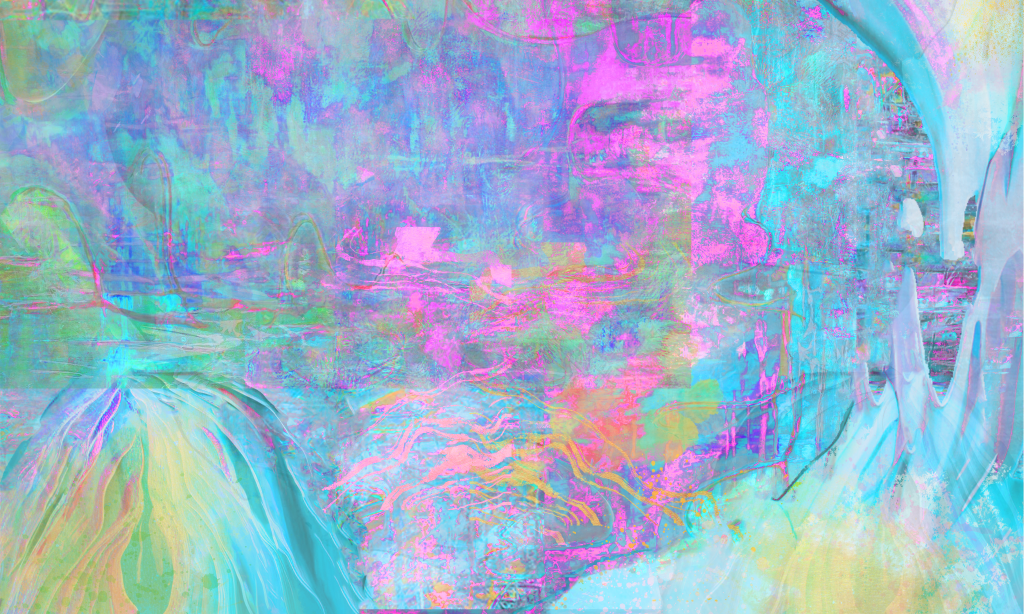
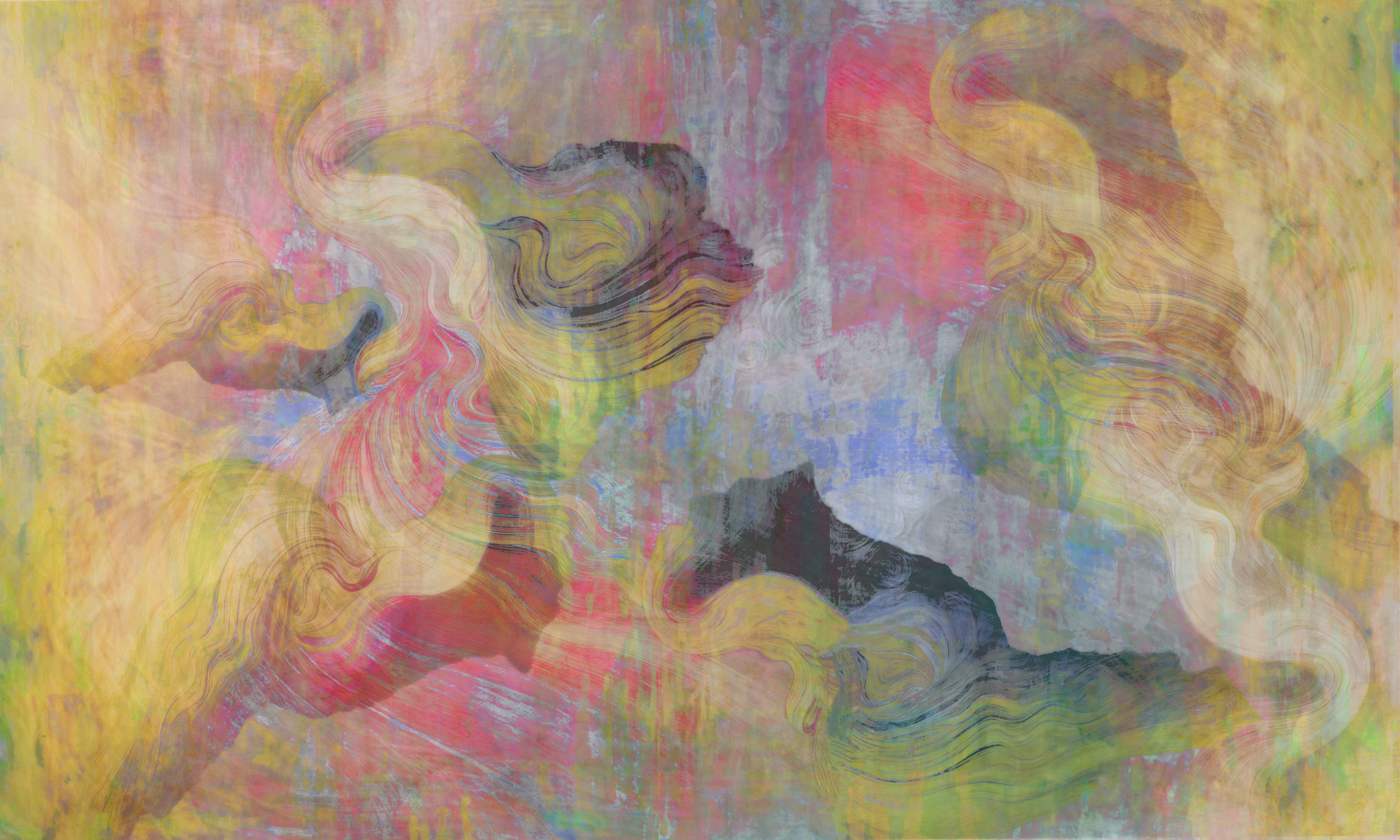
Angelis responds to each seed through acrylic painting, developing chromatic and gestural structures that negotiate between algorithmic logic and embodied mark making. Her approach aligns with women who work at the intersection of digital aesthetics and painterly experimentation, including Laura Owens, Jacqueline Humphries, and Amy Sillman, each of whom examines how screens, translation, and mediation reconfigure contemporary painting.
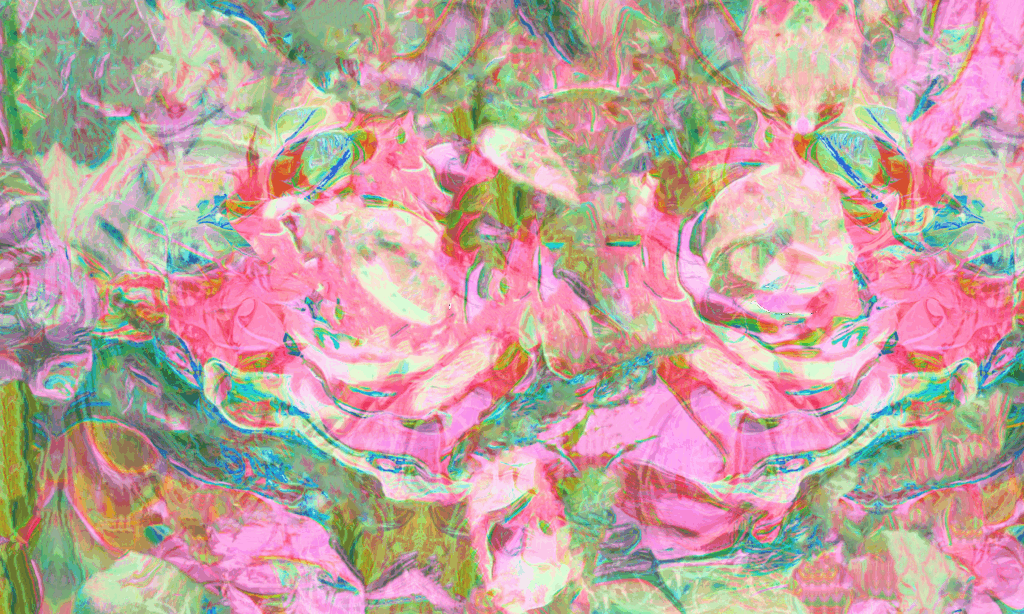
The paintings are then digitised and recomposed with their original seed images in Photoshop. Through layering, mirroring, and chromatic modulation, Angelis produces hybrid forms that exist between analogue and digital visual systems. This approach resonates with theoretical positions advanced by Rosi Braidotti, N. Katherine Hayles, and Donna Haraway, whose work considers how technological processes shape perception, agency, and embodied knowledge.
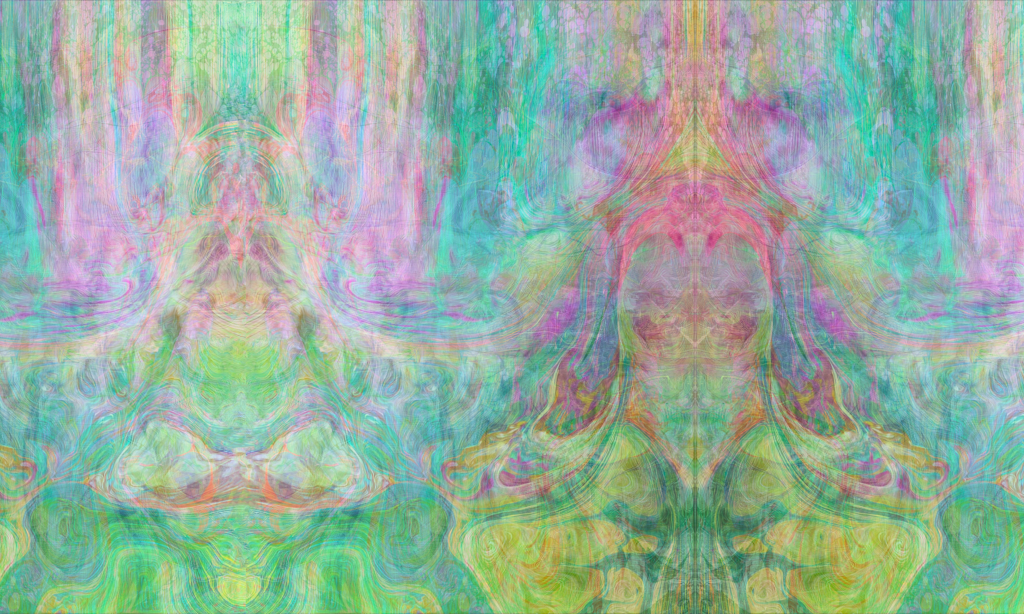
In the final stage, the hybrids are extended into looping mandalas that draw from global histories of geometric pattern, structuralist experiments by filmmakers such as Lis Rhodes, and contemporary practices in generative image culture led by women artists in computational art. Through this multistage process, Angelis positions translation between text, algorithm, gesture, and duration as a critical method. Her work demonstrates how intuition and computation co-produce visual form within contemporary posthuman environments.
Across this expanded workflow, Angelis treats digital and psychic technologies as parallel interfaces that recalibrate how images are sensed and understood. The resulting works invite viewers into an environment of perceptual drift, where intuition, code, memory, and materiality circulate without hierarchy. By foregrounding the slippages between these states, Angelis proposes a model of contemporary image making in which authorship is distributed, consciousness is porous, and visual meaning emerges through continual transformation.