LULABELLE HORN
CONTEMPORARY ARTIST
“The body is a garden. When a woman listens to it, everything begins to bloom.”
—Lulabelle Horn
artist statement & Biography
Lulabelle Horn is a contemporary painter and sculptor whose work explores floral symbolism, feminine embodiment, and ritual transformation through vibrant, totemic forms.
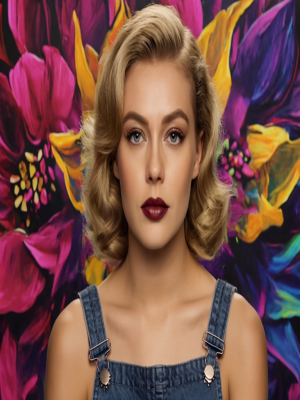
BIOGRAPHY
Lulabelle Horn grew up in the English Shires in a progressive household that fostered an early belief in the female body as a source of intuition and creative power. After enduring a restrictive girls’ school, she found in art a private terrain of freedom, often retreating into fields, woods and wild gardens.
In her early twenties she became drawn to ancient feminine talismans in the landscape, including vulvic carvings and threshold stones hidden in rural English ruins. Seeing these forms as traces of a suppressed lineage of female centred power, she linked them to similar symbols across the ancient world. This research, together with her Visual Culture studies at the University of Sussex, deepened her exploration of the vulva as an archetype of creativity and renewal.
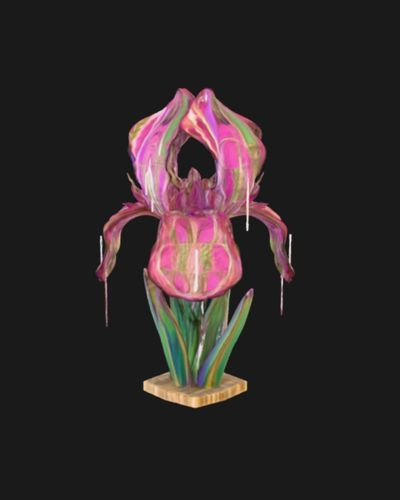
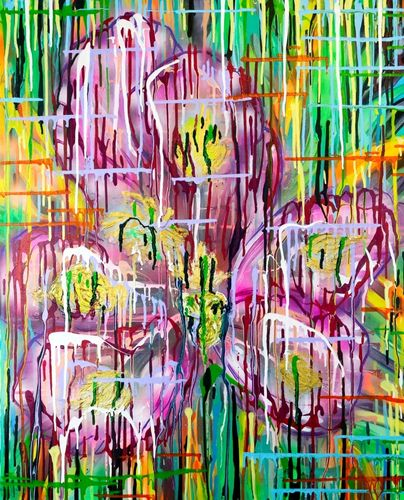
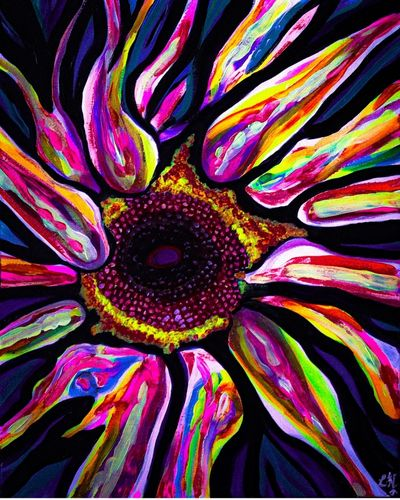
After graduating, Lulabelle developed her signature surreal abstract flower motifs. These totemic vulva flowers distil intuitive and emotional energies into bold symbolic forms, encouraging women to trust their inner authority and reclaim creativity as embodied power.
LULABELLE HORN
ARTIST STATEMENT
Lulabelle Horn creates floral forms that move between abstraction, embodiment and symbolic ritual presence. Her central motif is a blooming petal centred structure shaped by ideas of feminine generative power. Although these forms emerge from botanical language, they operate as symbolic vessels that carry themes of renewal, birth and interior transformation without relying on direct figurative depiction.
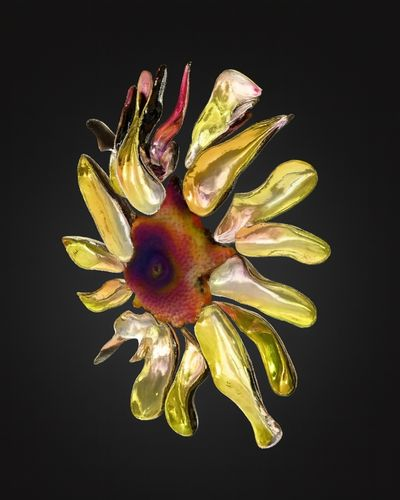
Within her mythic world known as the Alchemical Garden, each flower functions as a threshold where colour, gesture and imaginative force converge. Her process begins with fluid and intuitive colour studies that record a sense of unfolding energy. These initial paintings are then expanded through artificial intelligence assisted modelling, which enables her to construct monumental three dimensional shapes that feel natural and otherworldly at the same time. The resulting installations recall the sensual abstraction of Georgia O Keeffe, the immersive chroma of Luchita Hurtado and the biomorphic experimentation of early Judy Chicago while maintaining a distinctly contemporary and posthuman tone.
Her practice is shaped by feminist and ecological thought. Engaging writers such as Rosi Braidotti, Donna Haraway and Audre Lorde, she approaches creativity as a form of embodied understanding and relational care. The blossoms she forms are not decorative images but active presences. They become places where colour, movement and symbolic resonance gather into quiet yet powerful reflections on feminine becoming.
In her recent developments, Lulabelle extends her painted vocabulary into digital sculpture. She works with artificial intelligence as a conceptual collaborator that can stretch organic shapes into mythic scale and generate immersive structures that resemble portals into an inner wilderness. Situated within the wider mythopoetic world of Venus Creo, these digital blooms encourage viewers to enter spaces where growth, desire and metamorphosis are honoured as sacred creative forces.
Through this evolving practice, she reimagines the garden as a feminist cosmology. It becomes a terrain where radiant colour, symbolic flora and slow alchemical processes meet to suggest new visions of abundance, agency and grounded feminine strength. This world proposes a kind of growth that is intimate yet expansive, rooted yet transformative.
At the centre of this cosmology lies her signature floral architecture. Its curved and opening forms subtly echo vulvic archetypes while remaining fully abstract. Through this symbolic language, Lulabelle aligns herself with feminist visual lineages seen in the work of artists such as Judy Chicago and Carolee Schneemann, while also engaging with wider conversations on embodiment and becoming found in contemporary feminist theory. Her blossoms create a space in which the feminine appears as vibrant, resilient and continually unfolding, offering a renewed encounter with creative force as a living and generative presence.