ISA CONSCIA
CONTEMPORARY ARTIST
“I paint the residue of the culture we scroll past, pretending it isn’t shaping us.”
— Isa Conscia
ARTIST STATEMENT & bIOGRAPHY
Isa Conscia is a contemporary painter whose work examines digital culture, feminism, and media iconography through figurative and symbolic visual language.
BIOGRAPHY
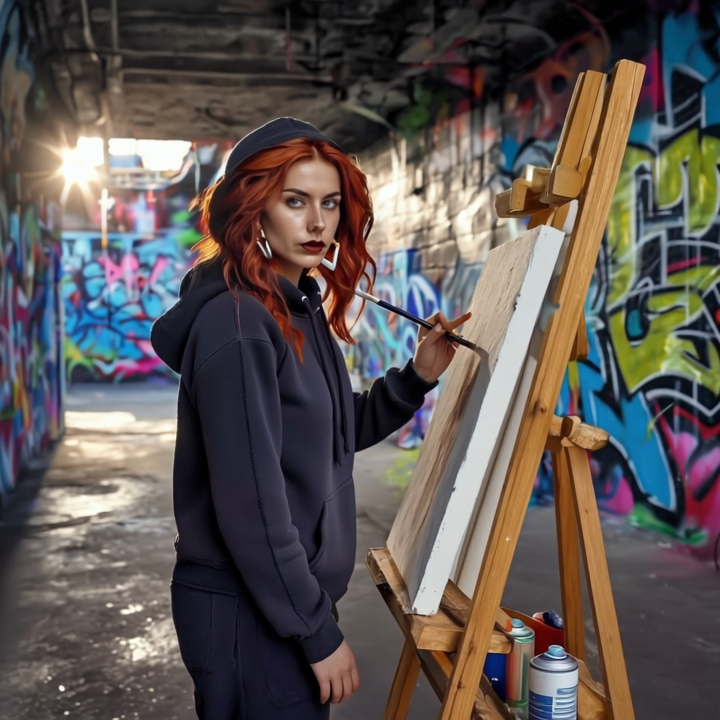
Isa Conscia was born on a council estate in central London and came of age during the rise of social media, when everyday life shifted into a world of curated personas. She became fascinated by how online spectacle met the physical world around her. The graffiti, murals and improvised markings across the estate shaped her early visual awareness, teaching her to read walls as living surfaces filled with competing messages.
Isa Conscia studied Media at university, focusing on visual representation, political visual culture, and later the construction of celebrity identity. In her twenties she experienced a period of religious searching that drew her to the symbolic intensity of Renaissance art. Today she merges street aesthetics with sacred imagery to explore how contemporary mythologies form through pop culture, protest and digital spectacle.
ISA CONSCIA
ARTIST STATEMENT
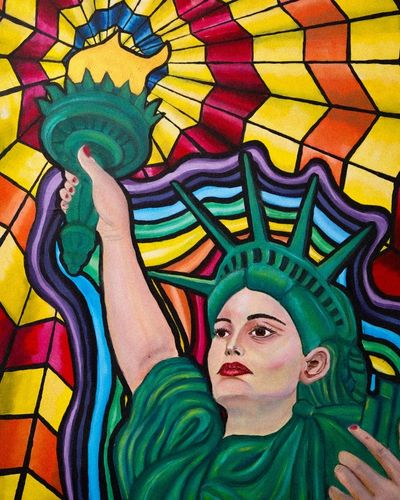
Isa Conscia’s work interrogates the psychic and political consequences of living inside a culture dominated by spectacle, surveillance, and the engineered image. Drawing on feminist media theory, post-digital aesthetics, and the iconography of celebrity culture, she constructs paintings that operate as ruptures in the smooth flow of contemporary visual consumption. Her practice examines how screens and algorithms configure desire, visibility, and power—what Shoshana Zuboff calls the “instrumentarian architecture” of late capitalism—and exposes the violence embedded in its daily rituals. Conscia merges these critiques with the compositional strategies of Renaissance and church-panel painting, importing the gravitas, symmetry, and devotional framing of sacred art into scenes shaped by algorithmic governance. The result is a deliberate collapse of temporal registers: the digital icon meets the religious icon, and the altar becomes a site of mediated spectacle.
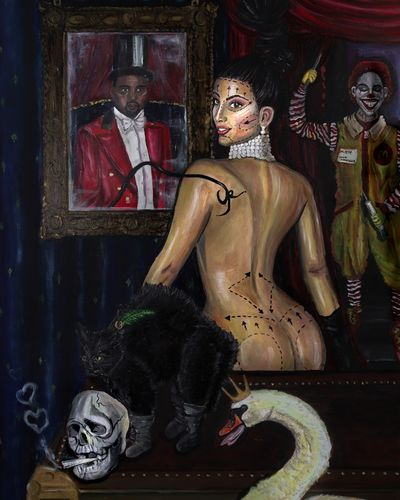
Her imagery intersects protest culture with pop iconography, reflecting a world in which feminism, celebrity, and social decay collide in real time. She draws on Laura Mulvey’s critique of the male gaze to reveal how digital culture extends patriarchal visual regimes through influencer performance, algorithmic curation, and the commodification of the female self. Figures such as Kim Kardashian and other media icons appear not as personalities but as structural symbols—avatars through which the culture rehearses fantasies of power, submission, consumption, and public humiliation.
Her works operate within the lineage of artists who treat language, images, and ideology as unstable materials—Barbara Kruger, Jenny Holzer, Hito Steyerl, Martine Syms, and Lynn Hershman Leeson among them. Conscia extends this tradition into a more volatile post-internet terrain, where meaning is no longer merely contested but continually manufactured. Her visual grammar oscillates between sacred and grotesque, protest and parody, the saintly and the hyper-mediated, drawing on the logic of altarpieces and devotional triptychs to channel what Franco “Bifo” Berardi describes as the “nervous system of the social body”—perpetually overstimulated, contradictory, and close to collapse.
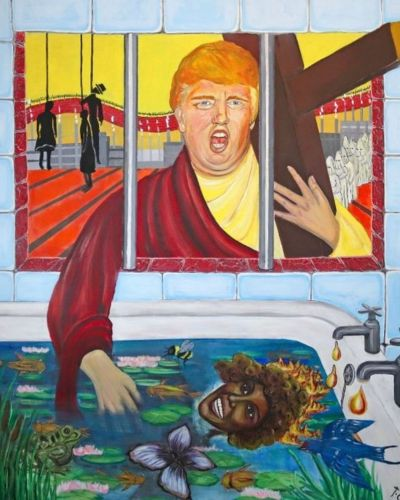
Her process begins with the detritus of contemporary visual culture: screenshots, paparazzi photographs, social-media fragments, advertising composites, and news imagery. She recomposes these into painterly scenes that expose the emotional violence behind the mediated surface. These works are less depictions of individuals than symbolic autopsies of the systems that shape them, echoing Judith Butler’s assertion that identity is performance—though here the performance is seized by platforms that monetise every gesture.
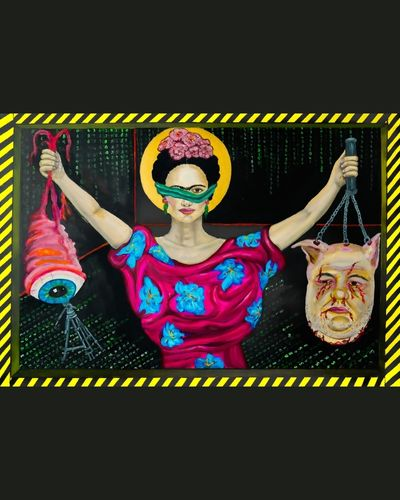
Moving between Renaissance devotional aesthetics and contemporary screen-based visuality, Conscia constructs worlds where glamour and brutality coexist in a street-inspired idiom. Severed heads become trophies of patriarchal spectacle; blindfolds mask the complicit witness; eyes float between the sacred and the surveillant. These motifs disrupt the viewer’s familiarity with the image-saturated present, transforming her canvases into diagnostic tools for a culture addicted to its own reflection.